


La Cour Suprême d’Israel a rejeté la demande de mise en liberté des 14 médecins de Gaza, dont le Dr Abu Safiya Sans prendre en compte le rapport d’expertise présenté….
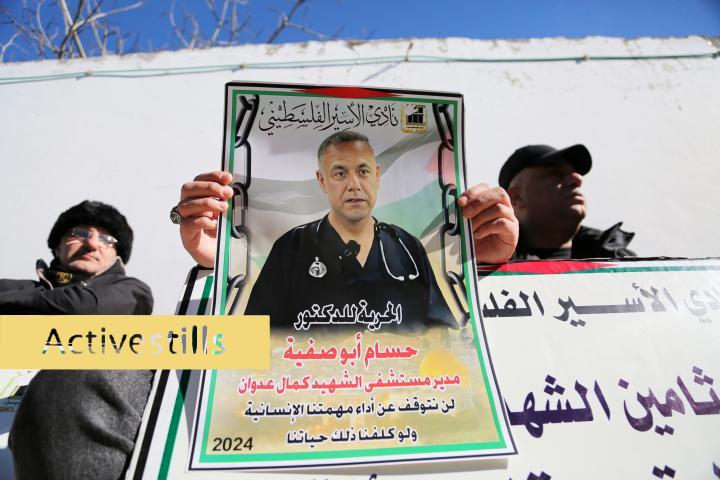
La Cour Suprême d’Israel a rejeté la demande de mise en liberté des 14 médecins de Gaza, dont le Dr Abu Safiya
Sans prendre en compte le rapport d’expertise présenté par le Professeur Amit Tirosh, spécialiste en endocrinologie et en médecine interne, la Cour Suprême d’Israel a rejeté la demande de mise en liberté des 14 médecins de Gaza, dont le Dr Abu Safiya, dont l’état de santé est extrêmement inquiétant. Tous sont détenus sans charge judiciaire ni procès. Cette décision a été prise en violation flagrante des droits humains, droits des médecins eux-mêmes, et droits des habitants de Gaza que l’on prive ainsi de leurs soignants, alors que la situation sanitaire ne cesse d’empirer.
Israeli Courts Reject Release of 14 Gaza Doctors Held Without Trial and Deny Dr. Abu Safiya an Independent Medical Examination
The two rulings leave 14 Gaza doctors, including hospital directors and medical specialists, in detention without charge or trial, while denying Dr. Hussam Abu Safiya an independent medical examination despite troubling findings in his medical records. The District Court ruling also reveals that the international campaign for his release was among the factors considered in rejecting his request
Two Israeli courts have rejected petitions filed by Physicians for Human Rights Israel (PHRI) concerning Palestinian doctors from Gaza detained without charge or trial. The Supreme Court dismissed PHRI’s petition seeking the release of 14 doctors, including hospital directors and specialists in essential medical fields. In a separate ruling, the Lod District Court rejected a petition to allow Dr. Hussam Abu Safiya, director of Kamal Adwan Hospital in northern Gaza, to undergo an independent medical examination and obtain a second medical opinion.
14 Doctors Detained Without Trial: Supreme Court Refuses to Intervene
In its petition, PHRI argued that the doctors’ continued detention, in some casesfor more than two years, violates their individual rights and further undermines Gaza’s healthcare system, which faces a severe shortage of medical professionals. PHRI called on the Israeli military’s Chief of Staff to exercisehis authority to revoke their detention orders under the Unlawful CombatantsLaw, particularly considering the ceasefire and Gaza’s urgent medical needs.
The Supreme Court dismissed the petition, finding no grounds to intervene in the Chief of Staff’s decision not to release the doctors. The state maintained that their cases had been reviewed in light of changing circumstances and the shortage of doctors in Gaza, but that no exceptional grounds had been found tojustify their release.
The Supreme Court also addressed the health of Dr. Abu Safiya, detained in Israelsince December 2024. Citing the state’s position, it stated that his health was not at risk and that he was receiving regular medical care. The Court also referred to last month’s District Court ruling denying his request for an independent medical examination.
14 Kilograms of Weight Loss: Medical Findings That Were NotAdequately Investigated
An expert medical opinion by Prof. Amit Tirosh, an independent Israeli specialist in internal medicine and endocrinology, raises serious questions about the medical picture presented to the court. Tirosh reviewed Abu Safiya’s medical records, obtained by PHRI from the Israel Prison Service (IPS). He had been expected to examine Abu Safiya as part of the petition rejected by the District Court.
According to Prof. Amit Tirosh, several medical findings were not adequately investigated. He also challenges the conclusion cited in the ruling that Abu Safiya had no medical problems other than high blood pressure.
Amongthe findings highlighted by Prof. Amit Tirosh is a substantial decline in Abu Safiya’s weight, from 90 kilograms in January 2025 to 76 kilograms in May of that year, which, he says, based on the medical file, did not receive sufficient medicalattention. Tirosh also identified inadequate investigation of complaints of chest pain, a delay of approximately one month in diagnosing scabies last year despite repeated requests for treatment, and deficiencies in medical documentation, including numerous reports that failed to identify the medical personnel responsible for the examinations.
Another concerning finding was a drop in Abu Safiya’s hemoglobin level, from 15.1 in February 2026 to 12.5 in July 2026. According to Tirosh, given the documented physical injuries and reports of loss of consciousness, this finding warranted further investigation to rule out potentially serious medical conditions.
The IPS medical records also document injuries following Abu Safiya’s transfer tothe Rakefet detention facility in June 2026. An examination on July 5 recorded bruising around his left eye, along with dizziness and rib pain.
Around the same time, Abu Safiya reported to his lawyers that he had been subjected to violence by prison guards, including punches, kicks and beatings with batons, as well as breathing difficulties and vision problems. His lawyer detailed these accounts in a sworn affidavit. According to prof. Amit Tirosh, the medical records do not explain how the injuries occurred, raising further questions that warrant an independent medical examination.
Responding to the District Court’s conclusion that Abu Safiya had no medical problemsother than high blood pressure, Prof. AmitTirosh wrote: « Put simply, the accountpresented in the court ruling is inconsistent with the data. »
Prof. Amit Tirosh was not permitted to examine Abu Safiya in person, and his medical opinion is based on the records made available to him, which extend only through July 2026. PHRI has no up-to-date information about Abu Safiya’s medical condition, as the IPS has so far refused to provide his updated medical records.
« Setting Up Organizations from Prison, Medical Manipulationand an International Campaign »: Questionable Allegations at the Basis ofthe Decision
Beyond the medical findings, the District Court ruling reveals some of the allegations presented by the Israeli authorities in opposing Abu Safiya’s independent medical examination, including intelligence claims presented to the court in exparte proceedings.
Among other things, the authorities alleged that Abu Safiya had manipulated his medical condition, established organizations from inside prison, influenced other prisoners and maintained international connections. The global campaign calling for his release was also included in the information presented to the court as a basis for a decision.
PHRI stresses that the findings in the IPS’s own medical records, together with Prof. Amit Tirosh’s expert opinion, directly challenge the allegation that Abu Safiya has « manipulated » his medical condition
The organization also questions how Abu Safiya could have allegedly established organizations or influenced other prisoners when he was held in isolation for aperiod beginning in June 2026 and is currently detained with only one other prisoner, without the ability to communicate with other inmates. The ruling doesnot identify the organizations he supposedly established or explain how hecould have done so under these conditions.
PHRI maintains that denying Abu Safiya an independent medical examination on thebasis of allegations concerning his public profile, international connectionsor supposed influence over other prisoners is unjustifiable. A medical examination is not equivalent to an ordinary visit by an outside individual. The right to a second medical opinion is enshrined in Israel’s Patients’ Rights Law and IPS regulations. It is not conditional on proving a life-threatening condition or a patient’s public standing.